


Contents
Scroll to:
 Open Access
 Subscription Access
https://doi.org/10.31089/1026-9428-2026-66-9-558-568
EDN: ztzeno
Scroll to:
Introduction. The transition to long term lunar and space missions requires a revision of methods for assessing the occupational risks faced by astronauts due to exposure to ionizing radiation (IR).
The study aims to propose, based on a systematic review, a model for calculating cosmic radiation doses for typical mission scenarios, and a comparative analysis of dose distribution when choosing protective materials for space suits, ships and stations.
Materials and methods. The authors used a deterministic model of linear dose accumulation based on data from the LRO (CRaTER), Curiosity (RAD), and DOSIS 3D instruments. The scientists developed a software package in Python for dosimetric planning and conducted a comparative analysis of radiation protection materials (regolith, HDPE, PEEK, basalt).
Results. The scientists have calculated the effective radiation doses: for a flight to the Moon — 5.4 mSv, to Mars — 378 mSv; for a one year stay at a lunar base without protection — up to 1200 mSv. It has been established that for stationary bases, the optimal choice is to use lunar regolith with boron containing additives (neutron absorption efficiency up to 92%), and for spacesuits — a multilayer combination of high density polyethylene and polyetheretherketone (PEEK).
Limitations. Analysis of radiation levels in space, the health effects of the "dose-effect" of astronauts, radiation safety standards.
Conclusion. Experts have substantiated the need for an approach to dose regulation based on risk assessment, the “time protection” strategy, and the use of special equipment/materials and local resources (ISRU) to minimize occupational risks in space.
Ethics. The conclusion of the biomedical ethics committee was not required for the study (the study was carried out on publicly available data and official regulatory databases).
Contributions:
Eryomin A.L. — research design, collection and processing of material, writing the text;
Evdokimov I.S. — development of a software package for dosimetric planning, analysis of materials for radiation protection.
All co-authors — approval of the final version of the article and ensuring the integrity of all parts of the article.
Funding. The study had no funding.
Conflict of interests. The authors declare no conflict of interest.
Received: 10.08.2026 / Accepted: 16.09.2026 / Published: 09.10.2026
Eryomin A.L., Evdokimov I.S. To assess the occupational radiation risk of astronauts and the prospects for the selection of methods and materials of protection. Russian Journal of Occupational Health and Industrial Ecology. 2026;66(9):558-568. https://doi.org/10.31089/1026-9428-2026-66-9-558-568. EDN: ztzeno
Introduction. The current strategy for the development of space exploration is characterized by a shift from short term orbital flights to the creation of permanent infrastructure in deep space. In 2024, cooperation between the Russian Federation and the People’s Republic of China on the creation of an International Scientific Lunar Station was legally enshrined [1], while NASA’s Artemis program and the Moon to Mars concept envisage the deployment of inhabited bases on the Moon as a springboard for Martian expeditions [2]. Ionizing radiation (IR) is one of the most dangerous and least manageable occupational risk factors in aerospace medicine [3]. In civil aviation, at the operating heights of flight personnel, the power of cosmic radiation exceeds the natural radiation background on the Earth's surface by dozens of times [4, 5]. However, in interplanetary space and on the surfaces of celestial bodies devoid of a dense atmosphere and a global magnetic field, AI levels increase by orders of magnitude, which creates the risk of not only stochastic oncological consequences but also deterministic tissue reactions [6, 7]. Ensuring radiation safety (RS) when planning interplanetary flights requires precision dosimetric control, taking into account the individual radiosensitivity of astronauts and designing effective protective barriers [8, 9].
The study aims to propose, based on a systematic review, a model for calculating doses from cosmic radiation for typical mission scenarios, and to conduct a comparative analysis of dose distribution when selecting protective materials for space suits, spacecraft, and stations.
Materials and methods. As part of the study, the physical parameters of four habitats were systematized: the Earth’s surface, low Earth orbit (LEO), using the International Space Station (ISS) as an example, and the surfaces of the Moon and Mars [1, 10, 11].
The assessment of the radiation environment was based on data from modern space based instrument systems: the CRaTER telescope aboard the Lunar Reconnaissance Orbiter (LRO) [10]; the RAD detector on the Curiosity rover [11]; and the DOSIS and DOSIS 3D dosimetric systems in the Columbus module on the ISS [12].
The assessment of radiation risk was carried out using the methodology for calculating the effective dose, as prescribed by the recommendations of the International Commission on Radiological Protection (ICRP) and the domestic radiation safety standards (RSS) [13, 14]. A deterministic model of linear dose accumulation was used to assess occupational risk. For multi phase missions, the total effective dose H was calculated using the formula:

where H is the total effective dose for the entire mission, mSv; Hi is the average effective dose rate during the first phase of the flight or stay (e.g., flight to Mars, stay on the surface), mSv/day or mSv/year; ti is the duration of the first phase, days or years; n is the number of mission phases. To automate the calculations, the authors have developed the software package "Space RadCalc" (Python/Rich), which allows modeling dose loads on critical organs (bone marrow, lens, skin) taking into account weighting factors in accordance with NRB 99/2009. The program is available in the public domain on SourceForge¹.
To select the optimal materials for radiation protection, a multi criteria analysis was carried out based on the parameters of the mass attenuation coefficient of ionizing radiation (IR), specific density, the cost of transportation to orbit, and the potential for using local space resources (ISRU technology — In Situ Resource Utilization) — a concept and a set of technologies aimed at extracting, processing, and using local resources on other celestial bodies [15–17].
Results and discussion. An analysis of the current standards shows significant differences in the approaches of national space agencies, hygienic RSS in sanitary rules and regulations (SanPiN), and occupational radiation standards in the RSS of the International Atomic Energy Agency (IAEA) (Table 1).

The risks associated with space exploration fall on the shoulders of a small group of people (cosmonauts, astronauts, taikonauts, and v’omanauts), but the benefits are enjoyed by the entire society. This imbalance places the responsibility on space agencies to ensure maximum protection for the specialists (the hull of the spacecraft and stations, spacesuits, exposure time) in order to minimize operational disruptions during the flight, throughout their entire career, and after leaving the agencies. Attempts are being made to predict the risks associated with lunar and Martian missions, taking into account their duration (days), absorbed doses (Gy), effective doses (mSv), and fatal risks (%) [8].
A systematization of the physical factors affecting humans in the studied habitats has been carried out. Special attention is paid to the role of the natural radiation background, temperature fluctuations, and the level of gravity, which synergistically affect the physiological adaptation of astronauts (Table 2).
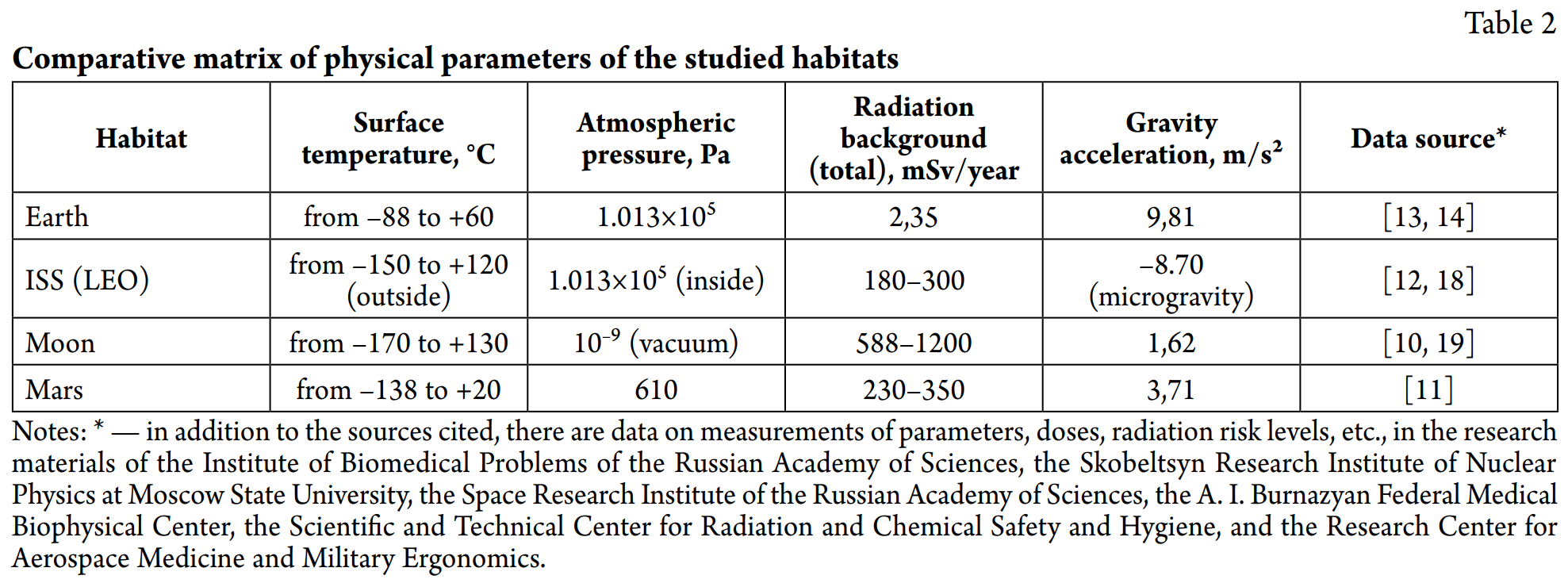
An analysis of the radiation parameters shows that on the surfaces of the Moon and Mars, IR becomes the dominant extreme occupational risk factor [15, 16, 19]. Based on formula (1), doses were calculated for five basic scenarios of manned missions (Table 3).
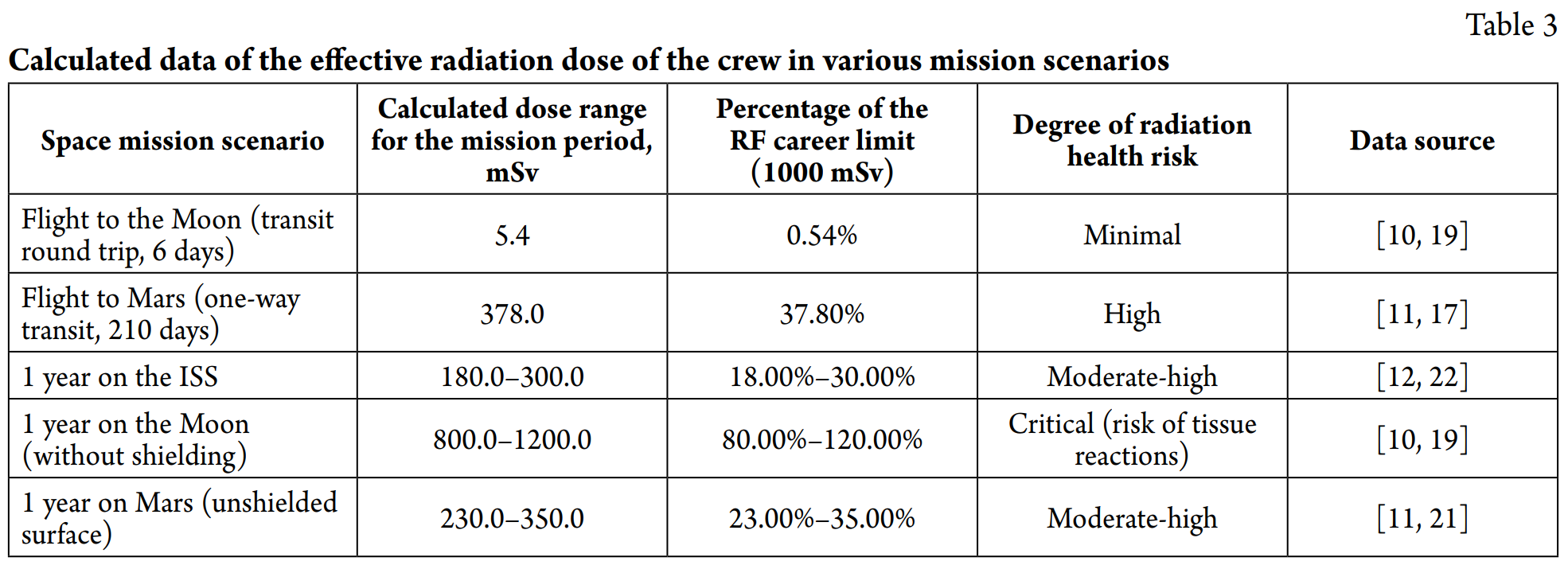
Table 3 shows the average data of the effective dose ranges measured by CRaTER (LRO), RAD (Curiosity) and DOSIS 3D (ISS) instruments and are not linked to a specific solar activity cycle (SA). The lower limits of the ranges (230 mSv/year for Mars and 800 mSv/year for the Moon) correspond to the period of maximum SA (minimum flux of galactic cosmic rays (GCR), the upper limits (350 and 1200 mSv / year) — the period of minimum SA (maximum flux GCR).
In risk based approaches, it is worth noting the significance of the Methodological Recommendations approved by Roscosmos and Federal Medical-Biological Agency (FMBA) on January 17, 2021 — "Limiting the Radiation Exposure of Astronauts during Flights in Near Earth Space" — which provide the conceptual foundations, dosimetric functions, and calculation formulas.
Near-term Generalized Dose (NGD) (in Russ. — generalized dose (Hb)) is a value used as a measure to determine the risk of adverse consequences for the performance and viability of crew members during a space flight.
Lifetime Generalized Dose (LGD) (in Russ. — generalized dose (Ho)) is a value used to assess the lifetime risk of long term adverse effects on the health and performance of astronauts (carcinogenic and non carcinogenic risks) after the completion of long duration missions and the astronauts’ careers in general; it is determined based on a specific set of coefficients, as other critical body systems and long term consequences are taken into account.
The obtained critical levels of radiation doses and risks at the level of the ISS’s near Earth orbits indicate the high relevance of developing and applying highly effective means of collective and individual protection during long duration manned space flights and stays on the surfaces of the Moon and Mars.
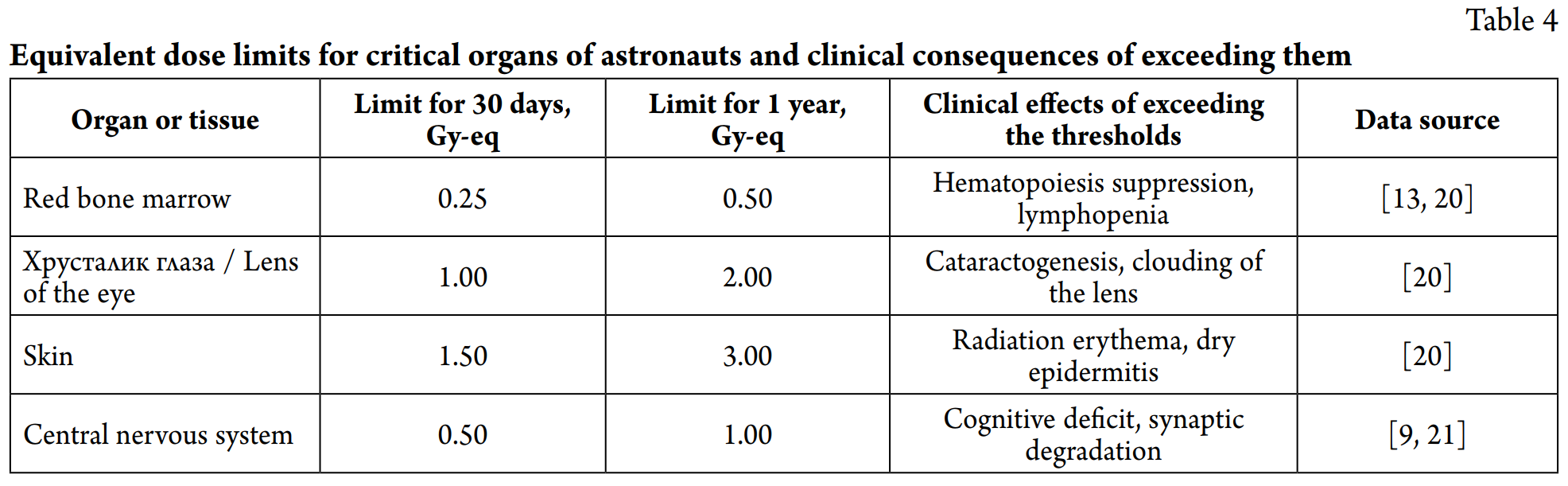
When planning missions, the calculation of radiation doses to critical organs should be compared with the threshold values of clinical manifestations in order to prevent the development of cataracts of the eye lens, cognitive impairments, and acute suppression of hematopoiesis (Table 4) [17, 20].
During deep space flights, conventional heavy metals (for example, lead) are ineffective due to their high atomic number, which, when interacting with the nuclei of galactic cosmic rays (GCR), triggers the formation of cascades of hard secondary braking radiation and neutron radiation [23]. A comparative analysis of promising passive protection materials is presented in Table 5 [15, 16, 22, 23].
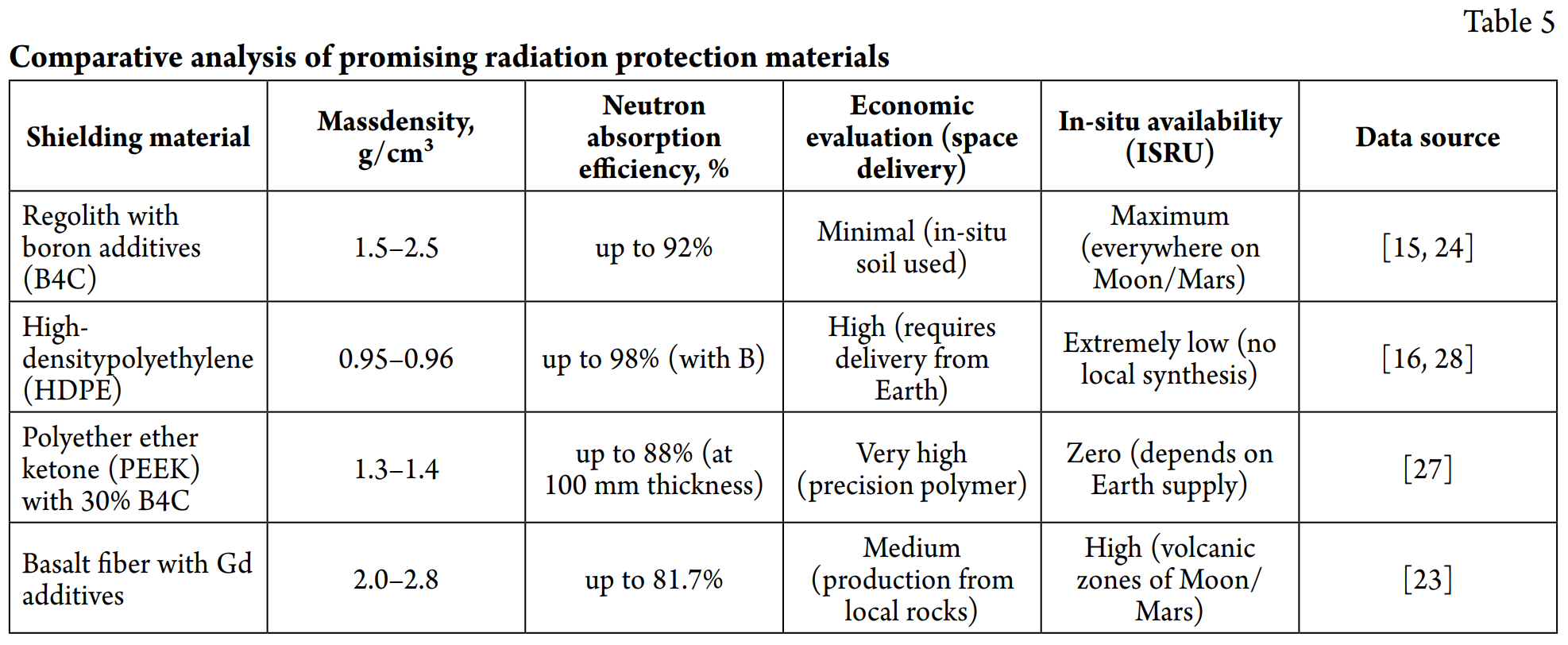
The introduction of boron compounds into polymer and regolith matrices ensures effective absorption of thermal and epithermal neutrons [15, 27]. Sintering of regolith makes it possible to produce durable protective blocks directly at the construction site (ISRU), reducing the cost of delivering heavy loads from Earth [15, 24].
For individual space suits (spacesuits), the most effective material is recognized as a multilayer polymer composition based on polyetheretherketone (PEEK) and high density polyethylene (HDPE), which provides a significant reduction in the dose load from GCR while maintaining mechanical strength and moderate weight [26-28]. According to some data, HDPE and regolith absorb up to 92–98 % of neutrons and weaken GCR by approximately 3–5 times.
In the context of discussion, it is worth noting the current contribution of Russian scientists to the development of the subject matter. The authors conducted an assessment of the neutron component of the radiation background on Mars [29].
The “Generalized Dose” was substantiated as the main dosimetric functional to normalize the effects of cosmic radiation to standard irradiation conditions on Earth (acute, short term, uniform irradiation from sources with a radiation quality factor (QF) of 1.0); based on it, an algorithm was developed and calculations of the total radiation risk (TRR) were carried out over the lifetime of cosmonauts of different ages after completing a two year mission to Mars, during the period of maximum SA, and also after the end of their career. Based on the generalized dose, the scientists calculated an integral indicator — the reduction in the average remaining life expectancy (ARLE) [30].
In 2021, a dependence was established in the Russian Federation. It is based on the maximum values of the relative biological effectiveness (RBE) coefficient for low absorbed doses in the range of 0.001–0.05 Gy, with respect to the risk of various long term effects from exposure to gamma radiation and neutrons, including damage to neurons in the cerebral cortex and the risk of developing cataracts. The RBE coefficients for these effects reach 50 or more [31]. The coefficients of modification (CM of NGD, CM of LGD (in Russ. КМБ, КМО) for the radiation response of the body in the short and long term have been substantiated, taking into account the cumulative effect of stress factors during long duration orbital and interplanetary flights [32]. Scientists have justified local radiation doses to tissues by presenting depth dose distributions for various protective materials and their thicknesses, taking into account the decrease in the efficiency of protons and helium ions during flights outside the Earth's magnetosphere; they have estimated the coefficient of modification of the body's radiation response CM LGD=2.0, taking into account other stress factors associated with interplanetary space flights [33].
Conclusion. Ionizing radiation in the conditions of deep space is the leading adverse occupational factor, capable of generating an effective radiation dose of 800–1200 mSv over a year of work at an unprotected lunar base, which significantly exceeds the career limit established in the Russian Federation.
The calculations of radiation doses for five typical flight scenarios showed that a hygienically permissible level of occupational risk is ensured only if a well developed passive protection system is created. The main danger during a flight to Mars (~378 mSv over 210 days) is heliospheric radiation, which requires the development of shields on a manned spacecraft.
The principle of using local resources (ISRU) has been substantiated as the optimal concept for the collective protection of lunar and Martian habitable bases: covering the modules with a protective layer of compressed regolith with the addition of boron, with a thickness of at least 1.5–2 m, combined with an inner layer of hydrogen containing polymer (HDPE).
When designing individual cosmonaut equipment (spacesuits), the use of multilayer polymer compositions based on PEEK and HDPE is justified, which reduce the dose from galactic cosmic rays while maintaining the necessary weight characteristics and high mechanical strength.
¹ https://sourceforge.net/projects/radiation/
1. Federal Law No. 128-FZ dated 12.06.2024. On Ratification of the Agreement between the Government of the Russian Federation and the Government of the People's Republic of China on Cooperation in the Field of Creation of the International Scientific Lunar Station. https://clck.ru/3Vsu5K (in Russian).
2. NASA. Moon to Mars Objectives. Washington: NASA; 2022. https://clck.ru/3VsvKq
3. Sakovich V.A. Sixty years of manned space flights in the light of the basic principles of radiation safety. Basic principles in the ICRP recommendations and Russian legislation. Radiatsiya i risk. 2022; 31(1): 64–73. https://elibrary.ru/odyjyo (in Russian).
4. Bukhtiyarov I.V., Zibarev E.V., Betts K.V. Epidemiological study on the analysis of mortality of civil aviation pilots in the Russian Federation. Aviakosmicheskaya i ehkologicheskaya meditsina. 2022; 56(4): 83–88. https://doi.org/10.21687/0233-528X-2022-56-4-83-88 (in Russian).
5. Scheibler C., Toprani S.M., Mordukhovich I., et al. Cancer risks from cosmic radiation exposure in flight: a review. Frontiers in Public Health. 2022; 10: 947068. https://doi.org/10.3389/fpubh.2022.947068
6. Shafirkin A.V., Benguin V.V., Shurshakov V.A. Comparison with the Radiation Safety Limits of the Dose Values to Critical Organs of the Human Body in Long-Term Missions to Orbital Stations Mir and ISS. Fiziologiya cheloveka. 2024; 50(7): 767–777. https://doi.org/10.1134/S0362119725700094 (in Russian).
7. Durante M. Space radiation protection: Destination Mars. Life Sciences in Space Research. 2014; 1: 2–9. https://doi.org/10.1016/j.lssr.2014.01.002
8. National Academies of Sciences, Engineering, and Medicine. Space Radiation and Astronaut Health: Managing and Communicating Cancer Risks. Washington, DC: The National Academies Press; 2021. https://doi.org/10.17226/26155
9. Cucinotta F.A., et al. Space radiation risks to the central nervous system. Life Sciences in Space Research. 2014; 2: 54–69. https://doi.org/10.1016/j.lssr.2014.06.003
10. Spence H.E., Case A.W., Smith S., et al. CRaTER: The Cosmic Ray Telescope for the Effects of Radiation on the Lunar Reconnaissance Orbiter. Space Science Reviews. 2010; 150(1–4): 243-284. https://doi.org/10.1007/s11214-009-9584-8
11. Hassler D.M., Zeitlin C., Wimmer-Schweingruber R.F., et al. The Radiation Environment on the Surface of Mars. Science. 2014; 343(6169): 1244797. https://doi.org/10.1126/science.1244797
12. Berger T., Mevel A., Reitz G., et al. DOSIS and DOSIS 3D: long-term dose monitoring on board the Columbus laboratory of the International Space Station. Journal of Space Weather and Space Climate. 2016; 6: A39. https://doi.org/10.1051/swsc/2016034
13. Bukhtiyarov I.V., Denisov E.I., Prokopenko L.V., et al. Methods of occupational risk assessment and their information support. Hygiene and Sanitation, Russian journal. 2019; 98(12): 1327–1330. https://elibrary.ru/khteai (in Russian).
14. International Commission on Radiological Protection. ICRP Publication 147: Use of Dose Quantities in Radiological Protection. Annals of the ICRP. 2021; 50(1): 1–147. https://doi.org/10.1177/0146645320911864
15. Cesaretti G., Dini E., De Kestelier X., et al. Building components for an outpost on the Lunar soil by means of a novel 3D printing technology. Acta Astronautica. 2014; 93: 430–450. https://doi.org/10.1016/j.actaastro.2013.07.034
16. Naito M. et al. Applicability of composite materials for space radiation shielding of spacecraft. Life sciences in space research. 2021; 31: 71–79. https://doi.org/10.1016/j.lssr.2021.08.004
17. Zeitlin C., Hassler D.M., Cucinotta F.A., et al. Measurements of energetic particle radiation in transit to Mars on the Mars Science Laboratory. Science. 2013; 340(6136): 1080–1084. https://doi.org/10.1126/science.1235989
18. Mitrikas V.G. Effective doses of radiation exposure in Russian participants of the main expeditions to the ISS. Aviakosmicheskaya i ehkologicheskaya meditsina. 2022; 56(4): 21–26. https://elibrary.ru/rjgttp (in Russian).
19. Ivanov I.V., Burmistrov V.I., Matkevich E.I. Assessment of the radiation situation during short-term flights to the Moon and development of emergency limits. Meditsinskaya radiologiya i radiatsionnaya bezopasnost'. 2024; 69(1): 50–60. https://doi.org/10.33266/1024-6177-2024-69-1-50-60 (in Russian).
20. International Commission on Radiological Protection. ICRP Publication 118: ICRP Statement on Tissue Reactions / Early and Late Effects of Radiation in Normal Tissues and Organs. Annals of the ICRP. 2012; 41(1-2): 1–322. https://doi.org/10.1016/j.icrp.2012.02.001
21. Chancellor J.C., Blue R.S., Cucinotta F.A., et al. Limitations in predicting the space radiation health risk for exploration astronauts. npj Microgravity. 2018; 4: 8. https://doi.org/10.1038/s41526-018-0043-2
22. Reitz G., Berger T., Bilger T., et al. Astronaut's organ doses as inferred from measurements in a human phantom outside the International Space Station. Advances in Space Research. 2012; 49(9): 1380–1392. https://doi.org/10.1667/RR1559.1
23. Wan L., Wendner R., Cusatis G. A novel material for in situ construction on Mars: experiments and numerical simulations. Construction and Building Materials. 2016; 120: 222–231. https://doi.org/10.1016/j.conbuildmat.2016.05.046
24. Montes C., Broussard K., Gongre M., et al. Evaluation of lunar regolith geopolymer binder as a radioactive shielding material for space exploration applications. Advances in Space Research. 2017; 59(7): 1745-1752. https://doi.org/10.1016/j.asr.2015.05.044
25. Thibeault S.A., Fay C.C., Lowther S.E., et al. Nanomaterials for radiation shielding. MRS Bulletin. 2015; 40(10): 836–841. https://doi.org/10.1557/mrs.2015.225
26. Miller J., Zeitlin C., Cucinotta F.A., et al. Benchmark studies of the effectiveness of structural and internal materials as radiation shielding for the International Space Station. Radiation Research. 2003; 159(3): 381–390. https://doi.org/10.1667/0033-7587(2003)159[0381:BSOTEO]2.0.CO;2
27. Moonlek C., Promsing C., Sriprom W., et al. PEEK Nanocomposites Containing Bi₂O₃ or BaSO₄ for Space Radiation Shielding. Polymer Composites. 2025; 46(4): 15057–15075. https://doi.org/10.1002/pc.30113
28. Balachkov M.M., Melnikova A.S., Smykovskaya V.O., Yurchenko M.D. Study of properties of recycled high-density polyethylene in radiation protection materials. Proceedings of Universities. Nuclear Power Engineering. 2024; 30(3): 59-67 https://doi.org/10.26583/npe.2024.3.05 (in Russian).
29. Mitrofanov I.G., Litvak M.L., Sanin A.B., Semkova Y.V., Dachev Ts.P. Assessment of the neutron component of the background radiation in Gale crater on Mars. Astronomical Bulletin. 2023; 57(3): 199–208 https://doi.org/10.31857/S0320930X23030076 (in Russian).
30. Ushakov I.B. Cosmos. Radiation. Human. (Radiation barrier in interplanetary flights). Moscow: Nauchnaya kniga, 2021. https://elibrary.ru/durgfc (in Russian).
31. Shafirkin A.V., Grigoriev Yu.G., Ushakov I.B., Shurshakov V.A. Biological efficiency of fast neutrons and accelerated multiply charged ions for constructing a new dependence of cosmic radiation quality coefficients on linear energy transfer. Aviakosmicheskaya i ehkologicheskaya meditsina. 2021; 55(3): 5–15. https://doi.org/10.21687/0233-528x-2021-55-3-5-15 (in Russian).
32. Shafirkin A.V., Vasin A.L., Tatarkin S.V. To substantiate the coefficients of modification of the KMB and KMO radiation response of the body in the near and long-term periods due to the complex action of stress factors during long-term orbital and interplanetary flights. Aviakosmicheskaya i ehkologicheskaya meditsina. 2022; 56(4): 5–20. https://doi.org/10.21687/0233-528x-2022-56-4-5-20 (in Russian).
33. Shafirkin A.V., Bengin V.V., Shurshakov V.A. Local tissue doses during flight outside the Earth's magnetosphere for various spacecraft protection, taking into account the reduced effectiveness of protons and helium ions. Aviakosmicheskaya i ehkologicheskaya meditsina. 2025; 59(1): 44–54. https://doi.org/10.21687/0233-528x-2025-59-1-44-54 (in Russian).
Professor of the Department of Physics and Information Systems, Dr. of Sci. (Med.)
e-mail: aeremin@yandex.ru
Master's Student, Faculty of Physics and Technology, Kuban State University
e-mail: ilya18243@mail.ru
Eryomin A.L., Evdokimov I.S. To assess the occupational radiation risk of astronauts and the prospects for the selection of methods and materials of protection. Russian Journal of Occupational Health and Industrial Ecology. 2026;66(9):558-568. https://doi.org/10.31089/1026-9428-2026-66-9-558-568. EDN: ztzeno
 Email this article (Login required)
Email the author (Login required)
Email this article (Login required)
Email the author (Login required) 

Editorial office, 2rd froor, 31, Budyonnogo Ave., Moscow, Russian Federation, 105275
Federal State Budgetary Scientific Institution
«Izmerov Research Institute of Occupational Health» (FSBSI “IRIOH”)
tel.: +7 (495) 366-11-10
email: med.truda@mail.ru





